
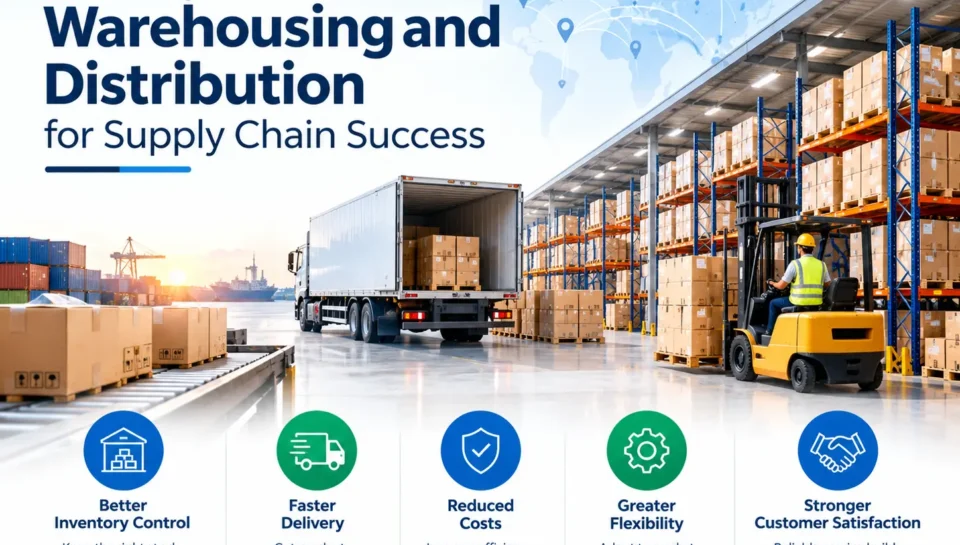
The Importance of Warehousing and Distribution for Supply Chain Success
Warehousing and Distribution for Supply Chain operations provide the storage, handling, and movement of goods needed to keep products available and deliveries organized. A well-managed warehouse does more than store inventory; it helps businesses control stock, coordinate orders, reduce delays, and maintain reliable delivery schedules.
For manufacturers, retailers, importers, exporters, and e-commerce businesses, efficient warehousing and distribution can directly influence customer satisfaction and operating costs. When inventory is stored correctly and moved through the right channels, businesses can respond to demand more effectively.
This guide explains how warehousing works within a supply chain, its key benefits, common challenges, important considerations, and how businesses can improve overall logistics performance.
What Is Warehousing and Distribution for Supply Chain Operations?
Warehousing and Distribution for Supply Chain operations involve storing goods safely and moving them from suppliers or manufacturers to the locations where they are needed. Warehousing focuses mainly on receiving, storing, organizing, and preparing inventory, while distribution manages the movement of goods toward customers or other destinations.
A typical process includes:
- Receiving incoming products.
- Checking and recording inventory.
- Storing products in suitable locations.
- Picking and packing customer orders.
- Dispatching goods through appropriate transportation.
- Tracking deliveries and updating inventory records.
Together, these activities connect purchasing, production, transportation, and customer delivery.
Why Are Warehousing and Distribution Important?
Effective warehousing and distribution help businesses maintain product availability while controlling storage, handling, and transportation activities. They create a connection between supply and demand, allowing goods to move through the supply chain in a more organized way.
Key advantages include:
- Better inventory visibility and control
- Faster order processing
- Reduced product handling errors
- Improved delivery coordination
- More efficient use of storage space
- Better customer service
- Greater supply chain efficiency
For businesses operating across multiple locations, strategically positioned warehouses can also reduce unnecessary transportation distances and simplify regional order fulfillment.
How Does Warehouse Management Support Supply Chain Efficiency?
Warehouse management is a key part of Warehousing and Distribution for Supply Chain operations. It involves controlling activities inside a warehouse, from receiving goods to preparing orders for dispatch. Its purpose is to ensure that inventory is stored accurately, accessible when required, and handled efficiently.
Important warehouse management activities include:
Inventory Management
Inventory management tracks what products are available, where they are stored, and when stock needs replenishment. Accurate records help prevent both stockouts and unnecessary overstocking.
Storage and Organization
Products should be placed according to factors such as size, weight, demand, handling requirements, and storage conditions. Clear labeling and organized storage can reduce picking time and errors.
Order Picking and Packing
Efficient picking systems help warehouse teams locate the correct products quickly. Proper packing protects goods during handling and transportation while helping ensure that orders are dispatched accurately.
What Role Does Distribution Management Play?
Distribution management coordinates how finished goods move from a warehouse to customers, retailers, businesses, or other destinations. It involves transportation planning, order scheduling, shipment coordination, documentation, and delivery monitoring.
An effective distribution process considers:
- Delivery locations and routes
- Shipment size and cargo characteristics
- Required delivery timelines
- Transportation options
- Handling requirements
- Customs or documentation needs for applicable shipments
Good coordination between warehouse and transportation teams reduces unnecessary delays and helps businesses maintain consistent delivery performance.
What Are the Main Types of Warehousing and Distribution Services?
Businesses can choose different arrangements depending on their products, shipment volumes, and operational requirements.
Common options include:
- Storage warehousing: Suitable for businesses that need secure space for inventory over a defined period.
- Distribution warehousing: Designed to support frequent receiving, order processing, and dispatch.
- Fulfillment services: Covers activities such as inventory storage, picking, packing, and shipment preparation.
- Specialized storage: Used for cargo requiring particular handling, security, temperature, or safety arrangements.
The right combination depends on the type of products, order frequency, geographic coverage, and required service levels.
How Can Businesses Choose the Right Warehousing Services in UAE?
Businesses selecting warehousing services in UAE should evaluate more than available storage space. The warehouse should fit the company’s inventory requirements, distribution network, shipment frequency, and operational processes.
Consider these factors:
- Location: Choose a facility that supports efficient access to suppliers, customers, ports, airports, or major transport routes.
- Storage capacity: Confirm that the facility can accommodate current inventory and expected growth.
- Handling capabilities: Check whether the warehouse can safely manage the type of cargo being stored.
- Inventory systems: Ask how stock movements and warehouse records are monitored.
- Distribution support: Determine whether warehousing connects efficiently with transportation and delivery services.
- Scalability: Ensure the arrangement can adapt to seasonal or long-term changes in demand.
For companies involved in international trade, coordination between storage, customs procedures, freight forwarding, and final delivery can be particularly important.
Common Warehousing and Distribution Problems
Poorly coordinated warehousing and distribution can create operational problems even when transportation itself is reliable.
Common issues include:
- Inaccurate inventory records
- Poor warehouse layout
- Delayed order picking
- Incorrect shipments
- Insufficient storage capacity
- Weak communication between warehouse and transport teams
- Poor demand forecasting
Businesses can reduce these problems by establishing clear processes, regularly reviewing inventory records, training staff, and using suitable warehouse management systems.
How to Improve Warehousing and Distribution Performance
Improvement starts with understanding where delays, errors, and unnecessary costs occur. Businesses should review the complete flow from receiving to final delivery rather than evaluating warehouse operations in isolation. This approach is especially useful when managing Logistics and Supply Chain Services, where warehouse and transportation activities need to work together efficiently.
Practical steps include:
- Monitor inventory accuracy regularly.
- Organize products according to movement and handling requirements.
- Standardize receiving, picking, packing, and dispatch procedures.
- Use digital inventory or warehouse management tools where appropriate.
- Track order processing and delivery performance.
- Coordinate warehouse schedules with transportation providers.
- Review storage capacity as business demand changes.
These measures can strengthen logistics and distribution while giving management better visibility across the supply chain.
How Warehousing Supports Long-Term Supply Chain Management
Warehousing is increasingly treated as part of broader Warehousing and Distribution for Supply Chain operations rather than simply a storage function. Businesses need warehouses that can respond to changing demand, support multiple distribution channels, and integrate with transportation and inventory systems.
Technology can also improve visibility through digital inventory records, barcode scanning, warehouse management platforms, and shipment tracking. The goal is not to adopt technology simply because it is available, but to use suitable tools to improve accuracy, visibility, and decision-making.
Conclusion
Warehousing and Distribution for Supply Chain operations form an important link between inventory and final delivery. Effective storage, accurate inventory management, organized order processing, and coordinated distribution can help businesses improve efficiency while reducing avoidable operational problems.
The right approach depends on the type of products, inventory volume, delivery requirements, geographic coverage, and business growth plans. Companies should therefore evaluate warehousing and distribution as an integrated part of their overall supply chain strategy rather than as separate activities. For businesses operating in the UAE, selecting suitable storage and logistics support can also help create a more organized path from incoming cargo to final delivery.
To explore reliable warehousing and logistics solutions tailored to your business needs, visit Al Sahel Cargo & Clearing LLC or get in touch with the team to discuss your requirements.
📧 info@alsahelgroup.com
📞 +971 2 672 4133
I’m Sajeena Kadir, Procurement Manager at Al Sahel Cargo & Clearing LLC, a trusted name in cargo and logistics services. With 18 years of experience at Al Sahel, I bring extensive knowledge of procurement, logistics, and supply chain operations. I’m passionate about efficient sourcing, reliable business solutions, and sharing valuable insights from the logistics industry.
Al Sahel Cargo & Clearing LLC
Frequently Asked Questions
What is the difference between warehousing and distribution?
Warehousing primarily focuses on receiving, storing, organizing, and preparing goods, while distribution focuses on moving those goods toward customers or other destinations. They are closely connected because accurate warehouse operations are necessary for efficient order fulfillment and delivery.
Why is inventory management important in warehousing?
Inventory management helps businesses know what stock they have, where it is located, and when replenishment may be required. Accurate inventory information can reduce stockouts, overstocking, picking errors, and delays while improving operational planning.
What should businesses consider when selecting a warehouse?
Businesses should consider location, storage capacity, cargo-handling requirements, inventory systems, security, distribution capabilities, scalability, and overall operating costs. Companies handling specialized or international cargo should also assess whether the facility can support their documentation and logistics requirements.
How does warehousing affect customer satisfaction?
Efficient warehousing helps ensure products are available, orders are picked correctly, and shipments are prepared on time. Better inventory accuracy and order processing can contribute to more reliable deliveries and fewer fulfillment problems.
Can warehousing reduce logistics costs?
Efficient warehousing can help control costs by improving storage utilization, reducing unnecessary handling, preventing inventory errors, and supporting better transportation planning. However, actual savings depend on warehouse location, inventory volume, product characteristics, labor, technology, and distribution requirements.
Why are warehousing services important for UAE businesses?
The UAE’s role as a major trade and logistics hub makes efficient storage and distribution important for businesses handling domestic and international shipments. Suitable warehousing can help companies coordinate inventory, transportation, order fulfillment, and distribution more effectively.