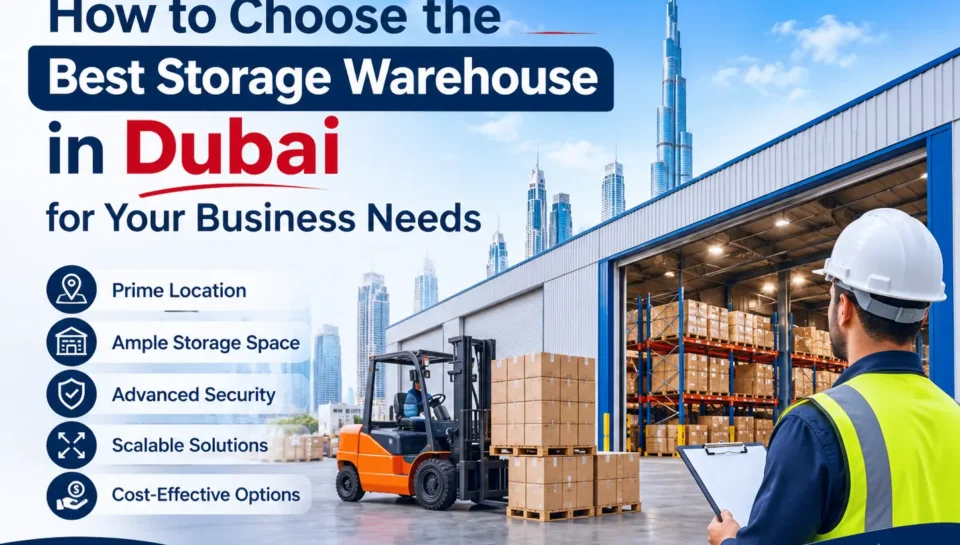
How to Choose the Best Storage Warehouse in Dubai for Your Business Needs
Choosing the right Storage Warehouse in Dubai directly affects your supply chain speed, inventory safety, and operating costs. Whether you run an e-commerce store, an import-export firm, or a retail brand, storing inventory in the wrong facility leads to damaged goods, delayed deliveries, and rigid lease expenses. Dubai offers a wide range of logistics hubs, each suited to different cargo types and distribution routes. Evaluating Warehousing and Distribution capabilities alongside infrastructure standards and contract terms can help you select a facility that supports your business requirements. This guide walks you through the key factors to consider before signing a warehouse lease.
Why Selecting the Right Storage Facility Matters for Dubai Businesses
A well-matched storage facility reduces last-mile delivery times, protects heat-sensitive stock, and lets you scale space up or down as order volumes shift. Businesses that treat warehousing purely as a low-cost space rental often face hidden expenses from stock spoilage, slow order fulfillment, or long-term lock-in contracts.
Selecting dependable commercial storage Dubai solutions turns inventory management into a competitive advantage. When your facility sits close to major transport corridors and offers modern inventory tracking, your team fulfills orders faster and avoids stock discrepancies.
Key Factors to Consider When Evaluating a Storage Warehouse in Dubai
To choose a Storage Warehouse in Dubai that aligns with your operational workflow, assess location, environmental controls, security, and contract flexibility before comparing price quotes.
1. Strategic Location and Transport Access
Proximity to ports, airports, and arterial highways determines how quickly goods move in and out of storage. Different Dubai logistics zones serve distinct business models:
- Jebel Ali Free Zone (JAFZA) & Dubai South: Ideal for import-export companies needing direct access to Jebel Ali Port and Al Maktoum International Airport.
- Al Quoz & Ras Al Khor: Centrally located for fast B2B distribution and same-day urban retail deliveries across Dubai.
- Dubai Investment Park (DIP): Offers modern industrial infrastructure with strong highway links to both Dubai and Abu Dhabi.
2. Climate-Controlled Infrastructure
Dubai’s summer temperatures frequently exceed 45°C, which can ruin electronics, cosmetics, pharmaceuticals, packaged foods, and wooden furniture. Investing in climate-controlled storage Dubai facilities ensures steady temperature and humidity regulation year-round. Always verify that the provider maintains backup generators and continuous temperature monitoring logs rather than relying on basic ventilation.
3. Security and Regulatory Compliance
Reliable warehousing companies in Dubai follow strict civil defense and municipal safety standards. During a site inspection, check for:
- 24/7 CCTV surveillance with recorded archives and biometric or badge-controlled access.
- Automated fire suppression sprinklers, smoke detectors, and valid Dubai Civil Defense (DCD) compliance certificates.
- Clean, pest-controlled loading bays with raised dock levelers for safe pallet handling.
4. Flexible Lease Terms and Scalability
Demand rarely stays flat across all twelve months. Look for warehouse storage for rent in Dubai that offers short-term and long-term storage Dubai options—such as pay-per-pallet pricing or modular square-footage agreements. Flexible terms keep you from paying for empty floor space during off-peak quarters while guaranteeing extra capacity during seasonal rushes.
5. Value-Added 3PL Services and Technology
Modern 3PL warehousing Dubai providers go beyond basic storage by handling order picking, packing, barcoding, and last-mile courier dispatch. Ask whether the facility uses a cloud-based WMS so you can monitor inventory without visiting the site. Choosing a provider with efficient Warehousing and Distribution for Supply Chain capabilities also helps streamline inventory movement, order fulfilment, and delivery coordination.
Common Mistakes to Avoid When Renting Warehouse Space
Many businesses rush into a lease based solely on the lowest rate per square foot. Watch out for these frequent pitfalls:
- Ignoring hidden operational fees: Clarify inbound/outbound handling charges, pallet wrapping fees, and after-hours access costs upfront.
- Overlooking customs status: Decide early whether you need a free zone bonded warehouse (to defer customs duties on re-exports) or a mainland facility for local UAE retail distribution.
- Skipping physical inspections: Photos rarely show floor load limits, ceiling clearance heights for high-bay racking, or traffic bottlenecks outside loading docks.
Step-by-Step Process to Choose Your Warehouse Partner
Follow these four practical steps to shortlist and finalize the right facility:
- Audit your inventory profile: Calculate total pallet volume, average monthly turnover, and temperature or hazardous-material requirements.
- Shortlist 3–4 providers by zone: Filter warehousing companies in Dubai based on proximity to your suppliers or end customers.
- Conduct an on-site walkthrough: Inspect cleanliness, climate-control equipment, fire safety systems, and WMS software live.
- Compare total landed cost: Request itemized quotes covering storage, handling, 3PL warehousing Dubai services, and contract exit terms before signing.
Conclusion
Finding the right Storage Warehouse in Dubai comes down to balancing location efficiency, climate protection, regulatory safety, and contract flexibility. Rather than choosing the cheapest square footage, prioritize facilities offering commercial storage Dubai businesses can scale easily, backed by transparent pricing, reliable security, and short-term and long-term storage Dubai plans. Look for providers offering reliable Logistics and Warehouse Solutions in Dubai to support inventory management, smooth cargo movement, and efficient distribution. Start by mapping your monthly pallet volume and scheduling on-site visits with two or three vetted providers in your target logistics zone to compare capabilities firsthand.
Need Reliable Warehouse Storage in Dubai?
Looking for a secure and efficient Storage Warehouse in Dubai for your business? Al Sahel Cargo & Clearing LLC offers reliable warehousing and logistics support to help manage your inventory and storage requirements.
Get in touch with our team today for more information and a customized quotation.
Call: +971 55 863 5933
Email: info@alsahelgroup.com
Website: www.alsahelgroup.com
Contact Al Sahel Today for Your Warehousing Requirements!
I’m Sajeena Kadir, Procurement Manager at Al Sahel Cargo & Clearing LLC, a trusted name in cargo and logistics services. With 18 years of experience at Al Sahel, I bring extensive knowledge of procurement, logistics, and supply chain operations. I’m passionate about efficient sourcing, reliable business solutions, and sharing valuable insights from the logistics industry.
Al Sahel Cargo & Clearing LLC
Frequently Asked Questions
How much does warehouse storage cost in Dubai?
Warehouse storage pricing in Dubai depends on location, climate control, and contract duration. Standard ambient storage typically starts around AED 35 to AED 65 per square foot annually in mainland zones, while warehouse storage for rent in Dubai priced per pallet generally ranges from AED 15 to AED 45 per pallet per week, excluding inbound and outbound handling fees. Choosing a suitable Storage Warehouse in Dubai can help businesses manage inventory costs according to their storage requirements.
What is the difference between a mainland warehouse and a free zone warehouse in Dubai?
A mainland warehouse (such as in Al Quoz) is ideal for businesses distributing directly to UAE retailers and local consumers. A free zone warehouse (such as in JAFZA or Dubai South) allows import-export companies to store goods without paying UAE customs duties until the cargo enters the local mainland market. Selecting the right Storage Warehouse in Dubai depends on your business location, distribution needs, and import-export activities.
When does a business need climate-controlled storage in Dubai?
You need temperature- and humidity-controlled storage if you store electronics, pharmaceuticals, cosmetics, chocolate, packaged food, fine art, or leather goods. Unregulated warehouses in Dubai can reach extreme indoor temperatures during summer, causing warping, melting, chemical degradation, or packaging damage.
Can I rent warehouse space in Dubai on a short-term basis?
Yes. Many third-party logistics providers offer flexible monthly or pay-per-pallet contracts instead of multi-year commercial leases. Short-term plans work well for seasonal inventory spikes, office renovations, or businesses testing demand in the UAE market before committing to dedicated square footage.
What certifications should a compliant warehouse in Dubai have?
A compliant facility must hold a valid trade license from the Dubai Department of Economy and Tourism (DET) or the relevant free zone authority, alongside an active safety clearance certificate from Dubai Civil Defense (DCD). Food and pharmaceutical facilities also require approval from Dubai Municipality or the Ministry of Health and Prevention (MOHAP).